The VMRC console has disconnected…attempting to reconnect

This morning I received an error I haven’t seen before when trying to open the console of a VM in our ESXi 5.5 environment….  “The VMRC console has disconnected…attempting to reconnect.” There are two ways to fix this. The easy way is to reboot your computer 🙂 If you would want to avoid a reboot you can do the following: Close out all of your VMware vSphere Clients and open Task Manager. You will want to make sure all processes named “vmware-vmrc.exe“, “vmware-remotemks.exe“, and “vpxclient.exe” are not running. If they are go ahead and end all those processes.   Now open up the vSphere Client, console should now work:   Comment below and let me know what worked for you!  

Multi-NIC vMotion

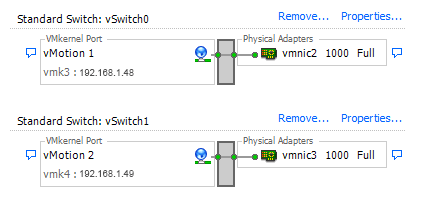
In vSphere 5 a new feature was added that many people may be overlooking. It is called Multi-NIC vMotion. If you have a environment where you have 2 or more dedicated uplinks reserved for vMotion you can double the total bandwidth available by using this option. Do I have your attention? 🙂 Normally you would have 1 port group with both of your vMotion uplinks set to active like this: What if I told you when you are vMotioning a VM, the VMkernal is picking one of those uplinks and basicly ignoring the other? According to the VMware KB article 2010877, “The VMkernel TCP/IP stack uses a single routing table to route traffic. If you have multiple VMkernel network interfaces (vmknics) that belong to the same IP subnet, the VMkernel TCP/IP stack picks one of the interfaces for all outgoing traffic on that subnet as dictated by the routing table.” If you want to use both uplinks for vMotion traffic and double your total bandwidth you have to create two vMotion VMkernals and assign each one a uplink. There was some issues with multi-NIC vMotions if you were running ESXi version before 5.0U2. As always try this out in your test enviroments first 🙂 Here is VMware KB2007467 walking you through these steps that compliment my steps below. First we will create a new port group and rename …

Read more…

Installing VMware ESXi and vCenter 5.5 [Part 1]

Installing VMware vSphere 5.5 Series: In this series I will be installing ESXi and vCenter using Microsoft Server 2012 R2 virtual machines. Part 1: Introduction and ESXi Installation Part 2: Microsoft SQL 2012 Installation Part 3: Creating the vCenter Database & ODBC Setup Part 4: vCenter 5.5 Installation Part 5: Initial Setup (Accessing vCenter, Configure Basic Permissions, Add Host) Downloading ESXi: If you will be running ESXi from a physical server you will want to use the ESXi image provider by the hardware manufacture such as Dell, HP, Cisco. Their ESXi image has the drivers and software specific for the hardware. If you will be running ESXi in a nested environment, then the ESXi image from VMware is what you want. Here are the download links for each manufacturer: HP: http://h18004.www1.hp.com/products/servers/software/vmware/esxi-image.html Dell: http://www.dell.com/support/home/us/en/19/Drivers/DriversDetails?driverid=5YC4T Cisco: http://www.cisco.com/c/en/us/td/docs/unified_computing/ucs/release/notes/OL_26617.html VMware: http://www.vmware.com/go/download-vspherehypervisor ESXi Installation: First boot your server from the ESXi ISO. Depending on your hardware you should mount the ISO using iLo/iDRAC/etc. Another nice way is to boot it from a USB thumb drive. You can make your USB bootable by using this tool: http://rufus.akeo.ie/ . Of course you can do it the old fashion way and burn the ISO to a disc. The first screen that pops up should look like this. It has a timer that will count down and automatically take you into the installer unless you hit a button …

Read more…

Installing VMware ESXi and vCenter 5.5 [Part 2]

Installing VMware vSphere 5.5 Series: Part 1: Introduction and ESXi Installation Part 2: Microsoft SQL 2012 Installation Part 3: Creating the vCenter Database & ODBC Setup Part 4: vCenter 5.5 Installation Part 5: Initial Setup (Accessing vCenter, Configure Basic Permissions, Add Host) I am installing Microsoft SQL 2012 on a Microsoft Server 2012 R2 virtual machine. In this walk through I am installing SQL and vCenter on separate virtual machines. Microsoft SQL 2012 Installation: 1. Go to the Installation tab and click on the New SQL Server stand-alone installation: 2. Setup Support Rules – It will run a quick preinstall scan. Click Next: 3. Product Key – You can proceed with an 180 day Evaluation, Express or enter your product key, click Next with your selection: 4. License Terms – Check the box to accept the license terms, check the box if you want to send usage data to Microsoft (who wouldn’t? 🙂 ) now click Next: 5. Product Updates – Go ahead and install the updates, click Next: 6. Setup Support Rules – It will run another test, click Next: 7. Setup Role – Ensure SQL Server Feature Installation is selected, click Next: 8. Feature Selection – Check the following options:      a. Database Engine Services      b. Client Tools Connectivity      c. Integration Services      d. Management Tools – Basic   …

Read more…

Installing VMware ESXi and vCenter 5.5 [Part 3]

Installing VMware vSphere 5.5 Series: Part 1: Introduction and ESXi Installation Part 2: Microsoft SQL 2012 Installation Part 3: Creating the vCenter Database & ODBC Setup Part 4: vCenter 5.5 Installation Part 5: Initial Setup (Accessing vCenter, Configure Basic Permissions, Add Host) Now that we have SQL installed its time to setup the vCenter database and ODBC connections. Creating the vCenter Database If you are experienced in SQL you can set the database up manually or use the provided schema SQL script from VMware vCenter installation media. In this install i’ll be using the VMware provided DB schema. This can be obtained in the \\vCenter Installation Media\vCenter-Server\dbschema\DB_and_schema_creation_scripts_MSSQL.txt  To make it easier below is a copy/paste of the script. You will have to change the database name, username, password and database location to match your setup. use [master] go CREATE DATABASE [VCDB] ON PRIMARY (NAME = N’vcdb’, FILENAME = N’C:\VCDB.mdf’ , SIZE = 3000KB , FILEGROWTH = 10% ) LOG ON (NAME = N’vcdb_log’, FILENAME = N’C:\VCDB.ldf’ , SIZE = 1000KB , FILEGROWTH = 10%) COLLATE SQL_Latin1_General_CP1_CI_AS go use VCDB go sp_addlogin @loginame=[vpxuser], @passwd=N’vpxuser’, @defdb=’VCDB’, @deflanguage=’us_english’ go ALTER LOGIN [vpxuser] WITH CHECK_POLICY = OFF go CREATE USER [vpxuser] for LOGIN [vpxuser] go CREATE SCHEMA [VMW] go ALTER USER [vpxuser] WITH DEFAULT_SCHEMA =[VMW] go Open SQL Server Management Studio and login using an account that has access: Now click on …

Read more…

Installing VMware ESXi and vCenter 5.5 [Part 4]

Installing VMware vSphere 5.5 Series: Part 1: Introduction and ESXi Installation Part 2: Microsoft SQL 2012 Installation Part 3: Creating the vCenter Database & ODBC Setup Part 4: vCenter 5.5 Installation Part 5: Initial Setup (Accessing vCenter, Configure Basic Permissions, Add Host) Now we are ready to start installing vCenter! VMware vCenter 5.5 Installation: A simple install will install all components on the same box. On our install we will have everything running on the same box however we will run through each component manually just to see the full install process. There is a specific order in which vCenter needs to be installed. The order is as follows: Single Sign-On Web Client Inventory Service vCenter Server First we will start out with Single Sign-On (SSO), click Install: Click Next: Accept the terms and click Next: This will perform a check, if the server is on a domain check the box, click Next: Since this is our first vCenter installation, use the first option and click Next: Enter a password for the SSO admin account. Make sure you don’t lose this password! Click Next: Enter your site name, click Next: Port 7444 will need to be open on the Windows Firewall, click Next: Change directories/drive if you need to, click Next: Review Install Options – Once you are satisfied click Install: SSO is now installed. Click Finish: Next …

Read more…

Installing VMware ESXi and vCenter 5.5 [Part 5]

Installing VMware vSphere 5.5 Series: Part 1: Introduction and ESXi Installation Part 2: Microsoft SQL 2012 Installation Part 3: Creating the vCenter Database & ODBC Setup Part 4: vCenter 5.5 Installation Part 5: Initial Setup (Accessing vCenter, Configure Basic Permissions, Add Host) Here is how you access your vCenter using the web client or install the thick client. I will show you how to access the web client but will continue configuration of vCenter using the thick client. Accessing and Configuring vCenter: To access your web client, go to the following address in your browser: https://[vCenterServerNameorIPAddress]:9443 In the bottom left corner there will be a “Download the Client Integration Plug-In”, go ahead and click that link and install. The plugin enabled certain functions such as mounting OVA files and viewing VM consoles. To login enter the username and password we created during the install, click Login: To access vCenter using the thick client, enter the vCenter server name and the username/password we created during the install, click Login: First we will set permissions do you can log in with a domain account or local user. Click on Hosts and Clusters: Now click on the permissions tab, right click in the white and click Add Permission: You can add users from domain if available and the local users of the vCenter server. I have a domain and created …

Read more…

VMware vSphere Beta Program

VMware announced on their blog that they are launching the vSphere beta program. While this is open for anyone to sign up it is still a closed beta, meaning NDA (Non Disclosure Agreement). For full details check out the link below: http://blogs.vmware.com/vsphere/2014/06/now-open-vmware-vsphere-beta-program.html