
After a fresh deployment of the vCenter Server Appliance 6 (VCSA) I got the error below when using “Use Windows session credentials” check box on the thick and web client. After some searching I found VMware KB 2050701 which states this is a known issue affecting vCenter Server Appliance 5.1, 5.5, and 6.0.
vSphere 5.x
Unable to kill DCUI – ESXi 5.1
One of our ESXi 5.1 hosts entered a disconnected state with reason unknown. When I logged into the console of the server and checked the network settings everything checked out. Then I went into the ESXi shell to see what the network interfaces looked like and here laid the problem… the management vmkernel interface was not enabled. esxcli network ip interface list If you need to see what IP address is assign to each vmk, run this command: esxcli network ip interface ipv4 get Okay, no big deal…. that is a easy fix! But when I tried to enable it I received a “Unable to kill DCUI” error. esxcli network ip interface set -e true -i vmk0 I could not find any information about this error anywhere. With this production ESXi host disconnected and roughly 40 virtual machines still running on this server I admitted defeat and opened a support case with VMware. The VMware Support Engineer referenced internal KB article 2052878 with the fix below: First we need to find the processor ID of the DCUI. ps | grep -i DCUI Note: The number to the right of the Unable to kill DCUI error is NOT the PID. Use the command above Now kill that PID, it will not return anything if successful. kill -9 PID This should now let you enable the vmk interface esxcli network ip interface set …
Not able to see the SD Card on HP Gen 9 during ESXi 5.5 Installation
When trying to install HP ESXi 5.5 customized image on a HP Gen 9 BL460 blade server I was not able to see the SD card to install on. After trying a few things I found that switching the USB 3.0 mode to Auto instead of the defaulted On allowed ESXi installation to see the SD card. The internal card reader goes over the USB bus so this appears to be a bug and hopefully HP will have a update soon to fix it. Below is what I did to get through this issue: ESXi 5.5U2 Installation – If your not seeing the SD card, go ahead and reboot: Hit F9 on the boot screen to enter System Utilities: Hit Enter on the System Configuration: Hit Enter on the BIOS/Platform Configuration: Hit Enter on System Options: Hit Enter on USB Options: On USB 3.0 Mode, change the default value of Enabled to Auto. Now hit F10 to save and reboot. Now on ESXi installer screen you should see the SD card:
Disable ‘SSH for the host has been enabled’ message in vSphere 5
I always forget where to turn off the SSH for the host has been enabled warning message so i’m posting it here for safe keeping. 🙂 To turn this message off click on the host, go to the Configuration tab, then click on Advanced Settings. Scroll down to the UserVars section. The last field is called UserVars.SupressShellWarning, change the value from a 0 to a 1. The message will now be gone! Resources: http://kb.vmware.com/selfservice/microsites/search.do?language=en_US&cmd=displayKC&externalId=2003637
Guest customization runs on every boot
In our vSphere 5.1 update 2 environment we found that some of our Windows virtual machines were running guest customization every time they boot. This was causing them to loose their static IP address and take an additional 5 minutes to boot. To fix this issue, boot to Windows and open regedit. Navigate to to the following location: HKLM\System\CurrentControlSet\Control\Session Manager\ Edit the BootExecute key and remove all sysprepDecrypter.exe lines. We had some VMs with up to 10 entries! Your key should now look like this: Click OK. Now the VM will not perform the guest customization on every boot. To prevent future VMs you deploy from gaining this issue update your vSphere environment to at least 5.1 Update 5.
Authorize Exception Error when logging into vCenter
If you get the following error when logging into vCenter(5.1U5): “A general system error occurred: Authorize Exception” Restarting the Single Sign On service on your vCenter should resolve the issue. In my case the cause of this was due to the LDAP connection pool being exhausted. To confirm this check the ssoAdminServer.log found here: C:\Program Files\VMware\Infrastructure\SSOServer\log Do a search for the following error: No ManagedConnections available within configured blocking timeout If you find that around the time when you was logging in then your LDAP connection pool was exhausted. This issue is resolved in vSphere 5.5. The VMware KB article for this issue 2055448: http://kb.vmware.com/selfservice/microsites/search.do?language=en_US&cmd=displayKC&externalId=2055448
The VMRC console has disconnected…attempting to reconnect
This morning I received an error I haven’t seen before when trying to open the console of a VM in our ESXi 5.5 environment…. “The VMRC console has disconnected…attempting to reconnect.” There are two ways to fix this. The easy way is to reboot your computer 🙂 If you would want to avoid a reboot you can do the following: Close out all of your VMware vSphere Clients and open Task Manager. You will want to make sure all processes named “vmware-vmrc.exe“, “vmware-remotemks.exe“, and “vpxclient.exe” are not running. If they are go ahead and end all those processes. Now open up the vSphere Client, console should now work: Comment below and let me know what worked for you!
Multi-NIC vMotion
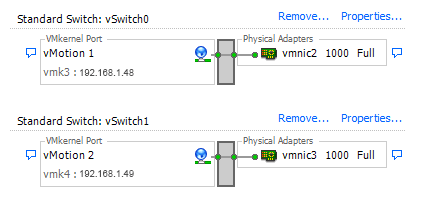
In vSphere 5 a new feature was added that many people may be overlooking. It is called Multi-NIC vMotion. If you have a environment where you have 2 or more dedicated uplinks reserved for vMotion you can double the total bandwidth available by using this option. Do I have your attention? 🙂 Normally you would have 1 port group with both of your vMotion uplinks set to active like this: What if I told you when you are vMotioning a VM, the VMkernal is picking one of those uplinks and basicly ignoring the other? According to the VMware KB article 2010877, “The VMkernel TCP/IP stack uses a single routing table to route traffic. If you have multiple VMkernel network interfaces (vmknics) that belong to the same IP subnet, the VMkernel TCP/IP stack picks one of the interfaces for all outgoing traffic on that subnet as dictated by the routing table.” If you want to use both uplinks for vMotion traffic and double your total bandwidth you have to create two vMotion VMkernals and assign each one a uplink. There was some issues with multi-NIC vMotions if you were running ESXi version before 5.0U2. As always try this out in your test enviroments first 🙂 Here is VMware KB2007467 walking you through these steps that compliment my steps below. First we will create a new port group and rename …
Installing VMware ESXi and vCenter 5.5 [Part 1]
Installing VMware vSphere 5.5 Series: In this series I will be installing ESXi and vCenter using Microsoft Server 2012 R2 virtual machines. Part 1: Introduction and ESXi Installation Part 2: Microsoft SQL 2012 Installation Part 3: Creating the vCenter Database & ODBC Setup Part 4: vCenter 5.5 Installation Part 5: Initial Setup (Accessing vCenter, Configure Basic Permissions, Add Host) Downloading ESXi: If you will be running ESXi from a physical server you will want to use the ESXi image provider by the hardware manufacture such as Dell, HP, Cisco. Their ESXi image has the drivers and software specific for the hardware. If you will be running ESXi in a nested environment, then the ESXi image from VMware is what you want. Here are the download links for each manufacturer: HP: http://h18004.www1.hp.com/products/servers/software/vmware/esxi-image.html Dell: http://www.dell.com/support/home/us/en/19/Drivers/DriversDetails?driverid=5YC4T Cisco: http://www.cisco.com/c/en/us/td/docs/unified_computing/ucs/release/notes/OL_26617.html VMware: http://www.vmware.com/go/download-vspherehypervisor ESXi Installation: First boot your server from the ESXi ISO. Depending on your hardware you should mount the ISO using iLo/iDRAC/etc. Another nice way is to boot it from a USB thumb drive. You can make your USB bootable by using this tool: http://rufus.akeo.ie/ . Of course you can do it the old fashion way and burn the ISO to a disc. The first screen that pops up should look like this. It has a timer that will count down and automatically take you into the installer unless you hit a button …
Installing VMware ESXi and vCenter 5.5 [Part 2]
Installing VMware vSphere 5.5 Series: Part 1: Introduction and ESXi Installation Part 2: Microsoft SQL 2012 Installation Part 3: Creating the vCenter Database & ODBC Setup Part 4: vCenter 5.5 Installation Part 5: Initial Setup (Accessing vCenter, Configure Basic Permissions, Add Host) I am installing Microsoft SQL 2012 on a Microsoft Server 2012 R2 virtual machine. In this walk through I am installing SQL and vCenter on separate virtual machines. Microsoft SQL 2012 Installation: 1. Go to the Installation tab and click on the New SQL Server stand-alone installation: 2. Setup Support Rules – It will run a quick preinstall scan. Click Next: 3. Product Key – You can proceed with an 180 day Evaluation, Express or enter your product key, click Next with your selection: 4. License Terms – Check the box to accept the license terms, check the box if you want to send usage data to Microsoft (who wouldn’t? 🙂 ) now click Next: 5. Product Updates – Go ahead and install the updates, click Next: 6. Setup Support Rules – It will run another test, click Next: 7. Setup Role – Ensure SQL Server Feature Installation is selected, click Next: 8. Feature Selection – Check the following options: a. Database Engine Services b. Client Tools Connectivity c. Integration Services d. Management Tools – Basic …